At the Start of His Career With the Esterhazy Family, Haydn Was

Franz Joseph Haydn [a] (; German: [ˈfʁants ˈjoːzɛf ˈhaɪdn̩] (  listen ); 31 March[b] 1732 – 31 May 1809) was an Austrian composer of the Classical period. He was instrumental in the development of chamber music such as the string quartet and pianoforte trio.[2] His contributions to musical course take led him to exist called "Father of the Symphony" and "Father of the String Quartet".[3] [iv]
Haydn spent much of his career equally a courtroom musician for the wealthy Esterházy family at their Eszterháza Castle. Until the after role of his life, this isolated him from other composers and trends in music then that he was, as he put it, "forced to become original".[c] Yet his music circulated widely, and for much of his career he was the almost celebrated composer in Europe.
He was a friend and mentor of Mozart, a tutor of Beethoven, and the older blood brother of composer Michael Haydn.
Biography [edit]
Early on life [edit]

Joseph Haydn was born in Rohrau, Austria, a village that at that time stood on the border with Republic of hungary. His father was Mathias Haydn, a wheelwright who also served every bit "Marktrichter", an office akin to hamlet mayor. Haydn's mother Maria, née Koller, had previously worked equally a cook in the palace of Count Harrach, the presiding aristocrat of Rohrau. Neither parent could read music;[d] even so, Mathias was an enthusiastic folk musician, who during the journeyman flow of his career had taught himself to play the harp. According to Haydn's later reminiscences, his babyhood family unit was extremely musical, and often sang together and with their neighbours.[5]
Haydn's parents had noticed that their son was musically gifted and knew that in Rohrau he would have no hazard to obtain serious musical training. It was for this reason that, around the fourth dimension Haydn turned six, they accepted a proposal from their relative Johann Matthias Frankh, the schoolmaster and choirmaster in Hainburg, that Haydn exist apprenticed to Frankh in his home to railroad train as a musician. Haydn therefore went off with Frankh to Hainburg and he never again lived with his parents.
Life in the Frankh household was non like shooting fish in a barrel for Haydn, who later remembered existence often hungry[six] and humiliated by the filthy state of his clothing.[7] He began his musical training there, and could soon play both harpsichord and violin. The people of Hainburg heard him sing treble parts in the church building choir.
There is reason to call back that Haydn's singing impressed those who heard him, because in 1739[e] he was brought to the attention of Georg von Reutter, the managing director of music in St. Stephen's Cathedral in Vienna, who happened to be visiting Hainburg and was looking for new choirboys. Haydn passed his audition with Reutter, and after several months of farther training moved to Vienna (1740), where he worked for the next nine years as a chorister.
Haydn lived in the Kapellhaus side by side to the cathedral, forth with Reutter, Reutter's family, and the other iv choirboys, which after 1745 included his younger brother Michael.[8] The choirboys were instructed in Latin and other school subjects too as voice, violin, and keyboard.[9] Reutter was of little help to Haydn in the areas of music theory and composition, giving him only two lessons in his unabridged time as chorister.[ten] Even so, since St. Stephen'south was ane of the leading musical centres in Europe, Haydn learned a swell deal simply past serving as a professional musician at that place.[eleven]
Like Frankh earlier him, Reutter did non e'er bother to make sure Haydn was properly fed. As he later told his biographer Albert Christoph Dies, Haydn was motivated to sing well, in hopes of gaining more invitations to perform before aristocratic audiences, where the singers were usually served refreshments.[12]

Struggles as a freelancer [edit]
By 1749, Haydn had matured physically to the bespeak that he was no longer able to sing high choral parts. Empress Maria Theresa herself complained to Reutter almost his singing, calling it "crowing".[13] 1 twenty-four hours, Haydn carried out a prank, snipping off the pigtail of a fellow chorister.[13] This was plenty for Reutter: Haydn was first caned, so summarily dismissed and sent into the streets.[fourteen] He had the good fortune to be taken in by a friend, Johann Michael Spangler, who shared his family's crowded garret room with Haydn for a few months. Haydn immediately began his pursuit of a career as a freelance musician.

Haydn struggled at commencement, working at many different jobs: as a music teacher, every bit a street serenader, and eventually, in 1752, every bit valet–accompanist for the Italian composer Nicola Porpora, from whom he later said he learned "the true fundamentals of composition".[xv] He was also briefly in Count Friedrich Wilhelm von Haugwitz's utilize, playing the organ in the Bohemian Chancellery chapel at the Judenplatz.[16]
While a chorister, Haydn had not received whatever systematic training in music theory and composition. Every bit a remedy, he worked his mode through the counterpoint exercises in the text Gradus ad Parnassum by Johann Joseph Fux and carefully studied the piece of work of Carl Philipp Emanuel Bach, whom he later acknowledged as an important influence.[17] He said of CPE Bach's first 6 keyboard sonatas, "I did not go out my clavier till I played them through, and whoever knows me thoroughly must notice that I owe a smashing bargain to Emanuel Bach, that I understood him and have studied him with diligence." Co-ordinate to Griesinger and Dies, in the 1750s Haydn studied an encyclopedic treatise by Johann Mattheson, a German composer.[eighteen]
As his skills increased, Haydn began to acquire a public reputation, first as the composer of an opera, Der krumme Teufel, "The Limping Devil", written for the comic actor Joseph Felix von Kurz, whose phase name was "Bernardon". The piece of work was premiered successfully in 1753, but was soon closed down by the censors due to "offensive remarks".[19] Haydn besides noticed, apparently without annoyance, that works he had simply given abroad were being published and sold in local music shops.[20] Between 1754 and 1756 Haydn also worked freelance for the court in Vienna. He was amongst several musicians who were paid for services as supplementary musicians at balls given for the imperial children during carnival flavor, and as supplementary singers in the regal chapel (the Hofkapelle) in Lent and Holy Week.[21]
With the increment in his reputation, Haydn eventually obtained aristocratic patronage, crucial for the career of a composer in his twenty-four hours. Countess Thun,[f] having seen one of Haydn's compositions, summoned him and engaged him as her singing and keyboard teacher.[g] In 1756, Baron Carl Josef Fürnberg employed Haydn at his country estate, Weinzierl, where the composer wrote his showtime string quartets. Of them, Philip G. Downs said "they abound in novel effects and instrumental combinations that can simply be the result of humorous intent".[22] Their enthusiastic reception encouraged Haydn to write more. Information technology was a turning point in his career. Equally a upshot of the performances, he became in great demand both as a performer and a instructor.[18] Fürnberg later on recommended Haydn to Count Morzin, who, in 1757,[h] became his first full-fourth dimension employer.[23] His salary was a respectable 200 florins a yr, plus complimentary board and lodging.[24]
The years as Kapellmeister [edit]
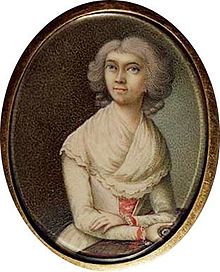
Haydn'due south job title nether Count Morzin was Kapellmeister, that is, music director. He led the count's minor orchestra in Unterlukawitz and wrote his commencement symphonies for this ensemble – perchance numbering in the double figures. Philip Downs comments of these start symphonies: "the seeds of the time to come are there, his works already exhibit a richness and profusion of cloth, and a disciplined nevertheless varied expression."[18] In 1760, with the security of a Kapellmeister position, Haydn married. His wife was the erstwhile Maria Anna Theresia Keller (1729–1800),[25] the sister of Therese (b. 1733), with whom Haydn had previously been in honey. Haydn and his wife had a completely unhappy marriage,[26] from which time permitted no escape. They produced no children, and both took lovers.[i]
Count Morzin soon suffered fiscal reverses that forced him to dismiss his musical establishment, but Haydn was quickly offered a similar chore (1761) by Prince Paul Anton, head of the immensely wealthy Esterházy family. Haydn'southward chore title was only Vice-Kapellmeister, but he was immediately placed in charge of nigh of the Esterházy musical establishment, with the one-time Kapellmeister Gregor Werner retaining authority only for church music. When Werner died in 1766, Haydn was elevated to full Kapellmeister.
Every bit a "firm officeholder" in the Esterházy institution, Haydn wore livery and followed the family as they moved among their various palaces, most importantly the family unit'south bequeathed seat Schloss Esterházy in Eisenstadt and subsequently on Esterháza, a yard new palace built in rural Hungary in the 1760s. Haydn had a huge range of responsibilities, including limerick, running the orchestra, playing chamber music for and with his patrons, and somewhen the mounting of operatic productions. Despite this arduous workload,[j] the job was in creative terms a superb opportunity for Haydn.[27] [28] The Esterházy princes (Paul Anton, and so from 1762 to 1790 Nikolaus I) were musical connoisseurs who appreciated his piece of work and gave him daily access to his ain small orchestra. During the nearly thirty years that Haydn worked at the Esterházy courtroom, he produced a overflowing of compositions, and his musical style connected to develop.
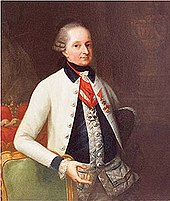
Much of Haydn'south activity at the fourth dimension followed the musical sense of taste of his patron Prince Nikolaus. In near 1765, the prince obtained and began to learn to play the baryton, an uncommon musical instrument similar to the bass viol, merely with a gear up of plucked sympathetic strings. Haydn was allowable to provide music for the prince to play, and over the adjacent ten years produced about 200 works for this instrument in diverse ensembles, the most notable of which are the 126 baryton trios. Around 1775, the prince abandoned the baryton and took up a new hobby: opera productions, previously a sporadic outcome for special occasions, became the focus of musical life at courtroom, and the opera theater the prince had congenital at Esterháza came to host a major season, with multiple productions each year. Haydn served as company director, recruiting and grooming the singers and preparing and leading the performances. He wrote several of the operas performed and wrote exchange arias to insert into the operas of other composers.
1779 was a watershed year for Haydn, as his contract was renegotiated: whereas previously all his compositions were the belongings of the Esterházy family unit, he now was permitted to write for others and sell his piece of work to publishers. Haydn shortly shifted his emphasis in limerick to reflect this (fewer operas, and more than quartets and symphonies) and he negotiated with multiple publishers, both Austrian and foreign. His new employment contract "acted as a catalyst in the adjacent stage in Haydn's career, the accomplishment of international popularity. By 1790 Haydn was in the paradoxical position ... of being Europe's leading composer, but someone who spent his time as a duty-bound Kapellmeister in a remote palace in the Hungarian countryside."[29] The new publication campaign resulted in the limerick of a great number of new string quartets (the half dozen-quartet sets of Op. 33, 50, 54/55, and 64). Haydn likewise composed in response to commissions from abroad: the Paris symphonies (1785–1786) and the original orchestral version of The 7 Last Words of Christ (1786), a commission from Cádiz, Espana.

The remoteness of Eszterháza, which was farther from Vienna than Eisenstadt, led Haydn gradually to feel more than isolated and lonely.[30] He longed to visit Vienna considering of his friendships there.[31] Of these, a peculiarly of import one was with Maria Anna von Genzinger (1754–1793), the wife of Prince Nikolaus's personal dr. in Vienna, who began a shut, platonic relationship with the composer in 1789. Haydn wrote to Mrs. Genzinger often, expressing his loneliness at Esterháza and his happiness for the few occasions on which he was able to visit her in Vienna. Later on, Haydn wrote to her frequently from London. Her premature death in 1793 was a blow to Haydn, and his F modest variations for pianoforte, Hob. XVII:6, may take been written in response to her death.[32]
Some other friend in Vienna was Wolfgang Amadeus Mozart, whom Haydn had met sometime around 1784. According to later testimony by Michael Kelly and others, the two composers occasionally played in string quartets together.[33] [34] Haydn was hugely impressed with Mozart'due south work and praised it unstintingly to others. Mozart evidently returned the esteem, as seen in his dedication of a set up of half-dozen quartets, now called the "Haydn" quartets, to his friend. In 1785 Haydn was admitted to the same Masonic lodge equally Mozart, the "Zur wahren Eintracht" in Vienna.[35] [one thousand]
The London journeys [edit]

In 1790, Prince Nikolaus died and was succeeded as prince past his son Anton. Following a trend of the fourth dimension,[37] Anton sought to economize by dismissing most of the courtroom musicians. Haydn retained a nominal appointment with Anton, at a reduced salary of 400 florins, as well as a 1000-florin pension from Nikolaus.[38] Since Anton had petty need of Haydn's services, he was willing to permit him travel, and the composer accustomed a lucrative offer from Johann Peter Salomon, a German violinist and impresario, to visit England and acquit new symphonies with a big orchestra.
The option was a sensible one considering Haydn was already a very popular composer there. Since the expiry of Johann Christian Bach in 1782, Haydn'south music had dominated the concert scene in London; "hardly a concert did non feature a piece of work past him".[39] Haydn's work was widely distributed by publishers in London, including Forster (who had their own contract with Haydn) and Longman & Broderip (who served every bit agent in England for Haydn's Vienna publisher Artaria).[39] Efforts to bring Haydn to London had been undertaken since 1782, though Haydn's loyalty to Prince Nikolaus had prevented him from accepting.[39]
After fond farewells from Mozart and other friends,[40] Haydn departed Vienna with Salomon on 15 December 1790, arriving in Calais in time to cross the English Channel on New year's Day of 1791. It was the first fourth dimension that the 58-year-one-time composer had seen the sea. Arriving in London, Haydn stayed with Salomon in Swell Pulteney Street (London, near Piccadilly Circus)[41] working in a borrowed studio at the Broadwood piano firm nearby.[41]
It was the start of a very auspicious catamenia for Haydn; both the 1791–1792 journey, along with a repeat visit in 1794–1795, were greatly successful. Audiences flocked to Haydn's concerts; he augmented his fame and made large profits, thus becoming financially secure.[fifty] Charles Burney reviewed the showtime concert thus: "Haydn himself presided at the piano-forte; and the sight of that renowned composer so electrified the audience, as to excite an attention and a pleasure superior to any that had ever been acquired past instrumental music in England."[yard] Haydn made many new friends and, for a time, was involved in a romantic relationship with Rebecca Schroeter.
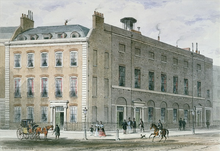
Musically, Haydn's visits to England generated some of his all-time-known piece of work, including the Surprise, Military, Drumroll and London symphonies; the Rider quartet; and the "Gypsy Rondo" piano trio. The great success of the overall enterprise does not mean that the journeys were free of trouble. Notably, his very first project, the commissioned opera L'anima del filosofo was duly written during the early on stages of the trip, but the opera's impresario John Gallini was unable to obtain a license to permit opera performances in the theater he directed, the Male monarch's Theatre. Haydn was well paid for the opera (£300) just much time was wasted.[n] Thus merely ii new symphonies, no. 95 and no. 96 Phenomenon, could exist premiered in the 12 concerts of Salomon's bound concert series. Another problem arose from the jealously competitive efforts of a senior, rival orchestra, the Professional Concerts, who recruited Haydn's quondam pupil Ignaz Pleyel every bit a rival visiting composer; the two composers, refusing to play forth with the concocted rivalry, dined together and put each other's symphonies on their concert programs.
The cease of Salomon'southward serial in June gave Haydn a rare catamenia of relative leisure. He spent some of the time in the country (Hertingfordbury), but also had fourth dimension to travel, notably to Oxford, where he was awarded an honorary doctorate past the university. The symphony performed for the occasion, no. 92 has since come to be known as the Oxford Symphony, although information technology had been written in 1789.[42]

While traveling to London in 1790, Haydn had met the young Ludwig van Beethoven in his native urban center of Bonn. On Haydn's render, Beethoven came to Vienna and was Haydn's pupil upwardly until the second London journey. Haydn took Beethoven with him to Eisenstadt for the summer, where Haydn had piddling to practise, and taught Beethoven some counterpoint.[43] While in Vienna, Haydn purchased a house for himself and his wife in the suburbs and started remodeling it. He as well arranged for the performance of some of his London symphonies in local concerts.
By the time he arrived on his second journey to England (1794–1795), Haydn had become a familiar figure on the London concert scene. The 1794 flavor was dominated by Salomon's ensemble, as the Professional person Concerts had abandoned their efforts. The concerts included the premieres of the 99th, 100th, and 101st symphonies. For 1795, Salomon had abandoned his own series, citing difficulty in obtaining "song performers of the beginning rank from abroad", and Haydn joined forces with the Opera Concerts, headed by the violinist Giovanni Battista Viotti. These were the venue of the last three symphonies, 102, 103, and 104. The final do good concert for Haydn ("Dr. Haydn's night") at the end of the 1795 season was a great success and was possibly the superlative of his English career. Haydn's biographer Griesinger wrote that Haydn "considered the days spent in England the happiest of his life. He was everywhere appreciated there; it opened a new world to him".[44]
Years of celebrity in Vienna [edit]
Haydn returned to Vienna in 1795. Prince Anton had died, and his successor Nikolaus II proposed that the Esterházy musical establishment be revived with Haydn serving again as Kapellmeister. Haydn took upwards the position on a part-fourth dimension basis. He spent his summers with the Esterházys in Eisenstadt, and over the course of several years wrote 6 masses for them including the Lord Nelson mass in 1798.

Wax sculpture of Haydn by Franz Thaler, c. 1800
Past this time Haydn had become a public effigy in Vienna. He spent most of his fourth dimension in his habitation, a large house in the suburb of Windmühle,[o] and wrote works for public performance. In collaboration with his librettist and mentor Gottfried van Swieten, and with funding from van Swieten'southward Gesellschaft der Associierten, he composed his two slap-up oratorios, The Cosmos (1798) and The Seasons (1801). Both were enthusiastically received. Haydn frequently appeared before the public, often leading performances of The Cosmos and The Seasons for charity benefits, including Tonkünstler-Societät programs with massed musical forces. He besides equanimous instrumental music: the popular Trumpet Concerto, and the last nine in his long serial of string quartets, including the Fifths, Emperor, and Sunrise. Directly inspired by hearing audiences sing God Save the King in London, in 1797 Haydn wrote a patriotic "Emperor's Hymn" Gott erhalte Franz den Kaiser, ("God Salve Emperor Francis"). This achieved great success and became "the enduring emblem of Austrian identity correct up to the First World War" (Jones)[ incomplete brusk citation ]. The tune was used for von Fallersleben'south Deutschlandlied (1841), which was written equally function of the German unification motility and whose third stanza is today the national canticle of the Federal Republic of Deutschland. (Mod Austria uses a different anthem.)
During the later years of this successful menstruum, Haydn faced incipient old historic period and fluctuating health, and he had to struggle to complete his final works. His last major work, from 1802, was the sixth mass for the Esterházys, the Harmoniemesse.
Retirement, illness, and death [edit]
By the cease of 1803, Haydn's condition had declined to the signal that he became physically unable to compose. He suffered from weakness, dizziness, inability to concentrate and painfully swollen legs. Since diagnosis was uncertain in Haydn'southward time, it is unlikely that the precise disease tin can ever be identified, though Jones suggests arteriosclerosis.[45] The disease was especially hard for Haydn considering the flow of fresh musical ideas connected unabated, although he could no longer work them out as compositions.[p] His biographer Dies reported Haydn proverb in 1806:
"I must accept something to do—unremarkably musical ideas are pursuing me, to the indicate of torture, I cannot escape them, they stand like walls before me. If information technology's an allegro that pursues me, my pulse keeps chirapsia faster, I can get no sleep. If it's an adagio, then I observe my pulse beating slowly. My imagination plays on me as if I were a clavier."[q] Haydn smiled, the blood rushed to his confront, and he said "I am really just a living clavier."

Business firm in Vienna (now a museum) where Haydn spent the terminal years of his life
The winding downwards of Haydn's career was gradual. The Esterházy family kept him on as Kapellmeister to the very stop (much as they had with his predecessor Werner long before), but they appointed new staff to lead their musical establishment: Johann Michael Fuchs in 1802 as Vice-Kapellmeister[46] and Johann Nepomuk Hummel as Konzertmeister in 1804.[47] Haydn's terminal summer in Eisenstadt was in 1803,[46] and his last appearance before the public every bit a conductor was a charity operation of The Vii Last Words on 26 December 1803. As debility set in, he fabricated largely futile efforts at limerick, attempting to revise a rediscovered Missa brevis from his teenage years and complete his final string quartet. The former project was abased for proficient in 1805, and the quartet was published with simply ii movements.[48]
Haydn was well cared for by his servants, and he received many visitors and public honors during his last years, merely they could not have been very happy years for him.[49] During his illness, Haydn often constitute solace by sitting at the piano and playing his "Emperor's Hymn". A concluding triumph occurred on 27 March 1808 when a performance of The Creation was organized in his honor. The very frail composer was brought into the hall on an armchair to the sound of trumpets and drums and was greeted by Beethoven, Salieri (who led the functioning) and by other musicians and members of the elite. Haydn was both moved and exhausted by the experience and had to depart at intermission.[fifty]

Haydn lived on for xiv more than months. His final days were hardly serene, every bit in May 1809 the French regular army under Napoleon launched an assail on Vienna and on 10 May bombarded his neighborhood. According to Griesinger, "4 case shots fell, rattling the windows and doors of his house. He called out in a loud vocalisation to his alarmed and frightened people, 'Don't be agape, children, where Haydn is, no harm can reach y'all!'. Only the spirit was stronger than the flesh, for he had hardly uttered the brave words when his whole body began to tremble."[51] More than bombardments followed until the city fell to the French on 13 May.[52] Haydn, was, still, securely moved and beholden when on 17 May a French cavalry officer named Sulémy came to pay his respects and sang, skillfully, an aria from The Creation.[r]
On 26 May Haydn played his "Emperor's Hymn" with unusual gusto 3 times; the same evening he collapsed and was taken to what proved to be to his deathbed.[51] He died peacefully in his own home at 12:40 a.m. on 31 May 1809, aged 77.[52] On 15 June, a memorial service was held in the Schottenkirche at which Mozart'south Requiem was performed. Haydn's remains were interred in the local Hundsturm cemetery until 1820, when they were moved to Eisenstadt past Prince Nikolaus. His head took a different journey; information technology was stolen past phrenologists before long afterward burial, and the skull was reunited with the other remains only in 1954, at present interred in a tomb in the north tower of the Bergkirche.
Character and appearance [edit]

Haydn'due south signature on a work of music: di me giuseppe Haydn ("past me Joseph Haydn"). He writes in Italian, a language he often used professionally.

Laus Deo ("praise be to God") at the conclusion of a Haydn manuscript.[due south]
James Webster writes of Haydn's public graphic symbol thus: "Haydn'south public life exemplified the Enlightenment platonic of the honnête homme (honest man): the man whose good grapheme and worldly success enable and justify each other. His modesty and probity were everywhere acknowledged. These traits were not but prerequisites to his success as Kapellmeister, entrepreneur and public effigy, simply likewise aided the favorable reception of his music."[53] Haydn was especially respected by the Esterházy courtroom musicians whom he supervised, as he maintained a cordial working temper and effectively represented the musicians' interests with their employer; see Papa Haydn and the tale of the "Farewell" Symphony. Haydn had a robust sense of humour, evident in his honey of applied jokes[54] and often apparent in his music, and he had many friends. For much of his life he benefited from a "happy and naturally cheerful temperament",[55] but in his later life, there is testify for periods of depression, notably in the correspondence with Mrs. Genzinger and in Dies's biography, based on visits made in Haydn's old age.
Haydn was a devout Catholic who often turned to his rosary when he had trouble composing, a practice that he usually found to be constructive.[56] He ordinarily began the manuscript of each composition with "in nomine Domini" ("in the name of the Lord") and ended with "Laus Deo" ("praise be to God").[57]
Haydn's early years of poverty and awareness of the financial precariousness of musical life made him astute and even sharp in his business dealings. Some contemporaries (usually, information technology has to be said, wealthy ones) were surprised and even shocked at this. Webster writes: "Every bit regards coin, Haydn…always attempted to maximize his income, whether by negotiating the right to sell his music outside the Esterházy court, driving hard bargains with publishers or selling his works three and four times over [to publishers in different countries]; he regularly engaged in 'sharp practise'" which nowadays might be regarded as apparently fraud.[58] Only those were days when copyright was in its infancy, and the pirating of musical works was common. Publishers had few qualms about attaching Haydn's proper noun to popular works by bottom composers, an arrangement that effectively robbed the lesser musician of livelihood. Webster notes that Haydn's ruthlessness in business might exist viewed more sympathetically in light of his struggles with poverty during his years as a freelancer—and that outside of the world of business, in his dealings, for instance, with relatives, musicians and servants, and in volunteering his services for charitable concerts, Haydn was a generous man – offer to teach the ii babe sons of Mozart for gratuitous after their father'southward death.[58] When Haydn died he was certainly comfortably off, simply past eye class rather than aristocratic standards.
Haydn was short in stature, perhaps as a result of having been underfed throughout most of his youth. He was not handsome, and like many in his 24-hour interval he was a survivor of smallpox; his face was pitted with the scars of this illness.[t] His biographer Dies wrote: "he couldn't sympathize how information technology happened that in his life he had been loved by many a pretty woman. 'They couldn't take been led to it past my beauty.'"[59]
His nose, large and aquiline, was disfigured past the polyps he suffered during much of his adult life,[lx] an agonizing and debilitating disease that at times prevented him from writing music.[61]
Works [edit]

James Webster summarizes Haydn'south role in the history of classical music as follows: "He excelled in every musical genre. ... He is familiarly known as the 'father of the symphony' and could with greater justice be thus regarded for the string quartet; no other composer approaches his combination of productivity, quality and historical importance in these genres."[4]
Structure and graphic symbol of his music [edit]
A central feature of Haydn's music is the development of larger structures out of very brusk, simple musical motifs, often derived from standard accompanying figures. The music is often quite formally concentrated, and the of import musical events of a movement can unfold rather chop-chop.[u]

Haydn'southward work was central to the development of what came to be called sonata grade. His practice, however, differed in some ways from that of Mozart and Beethoven, his younger contemporaries who also excelled in this grade of composition. Haydn was specially fond of the so-called monothematic exposition, in which the music that establishes the ascendant primal is similar or identical to the opening theme. Haydn also differs from Mozart and Beethoven in his recapitulation sections, where he often rearranges the gild of themes compared to the exposition and uses all-encompassing thematic development.[v]
Haydn'southward formal creativity also led him to integrate the fugue into the classical fashion and to enrich the rondo form with more cohesive tonal logic (see sonata rondo form). Haydn was also the principal exponent of the double variation form—variations on 2 alternating themes, which are ofttimes major- and modest-style versions of each other.
Perhaps more than whatsoever other composer's, Haydn's music is known for its humor.[west] The most famous example is the sudden loud chord in the slow movement of his "Surprise" symphony; Haydn's many other musical jokes include numerous false endings (eastward.1000., in the quartets Op. 33 No. 2 and Op. 50 No. 3), and the remarkable rhythmic illusion placed in the trio department of the third movement of Op. l No. one.[62]
Much of the music was written to delight and delight a prince, and its emotional tone is correspondingly upbeat.[ citation needed ] This tone as well reflects, perhaps, Haydn's fundamentally salubrious and well-balanced personality. Occasional minor-key works, frequently deadly serious in character, course striking exceptions to the general dominion. Haydn's fast movements tend to be rhythmically propulsive and oft impart a corking sense of energy, specially in the finales. Some characteristic examples of Haydn's "rollicking" finale type are institute in the "London" Symphony No. 104, the Cord Quartet Op. 50 No. ane, and the Piano Trio Hob Xv: 27. Haydn's early tedious movements are unremarkably not also slow in tempo, relaxed, and reflective. Later on on, the emotional range of the boring movements increases, notably in the deeply felt tiresome movements of the quartets Op. 76 Nos. 3 and 5, the Symphonies No. 98 and 102, and the Piano Trio Hob Xv: 23. The minuets tend to have a potent downbeat and a clearly pop character. Over fourth dimension, Haydn turned some of his minuets into "scherzi" which are much faster, at i beat to the bar.
One of the almost apt tributes to Haydn was spoken by the poet John Keats. Keats, dying of tuberculosis, was brought to Rome by his friends in November 1820, in the hope that the climate might help to mitigate his suffering. (The poet died a few weeks afterwards on 23 February 1821, at the age of 25.) Co-ordinate to his friend Joseph Severn: "Nearly this fourth dimension he expressed a potent want that nosotros had a pianoforte, so that I might play to him, for not merely was he passionately fond of music, but found that his abiding pain and o'erfretted nerves were much soothed by information technology. This I managed to obtain on loan, and Dr. Clark procured me many volumes and pieces of music, and Keats had thus a welcome solace in the dreary hours he had to pass. Among the volumes was ane of Haydn's Symphonies, and these were his delight, and he would exclaim enthusiastically, 'This Haydn is similar a child, for there is no knowing what he will do next.' "[63]
Style [edit]
Haydn'south early work dates from a menses in which the compositional style of the High Baroque (seen in J. South. Bach and Handel) had gone out of fashion. This was a period of exploration and doubt, and Haydn, born eighteen years earlier the death of Bach, was himself one of the musical explorers of this fourth dimension.[64] An older contemporary whose work Haydn acknowledged as an important influence was Carl Philipp Emanuel Bach.[17]
Tracing Haydn's work over the six decades in which it was produced (roughly from 1749 to 1802), one finds a gradual but steady increment in complexity and musical sophistication, which developed as Haydn learned from his own experience and that of his colleagues. Several important landmarks have been observed in the development of Haydn's musical manner.
In the tardily 1760s and early 1770s, Haydn entered a stylistic period known as "Sturm und Drang" ("tempest and stress"). This term is taken from a literary move of about the same time, though it appears that the musical evolution actually preceded the literary one past a few years.[x] The musical linguistic communication of this period is like to what went before, only it is deployed in piece of work that is more intensely expressive, especially in the works in small-scale keys. James Webster describes the works of this period every bit "longer, more passionate, and more than daring".[65] Some of the about famous compositions of this time are the "Trauer" (Mourning) Symphony No. 44, "Goodbye" Symphony No. 45, the Pianoforte Sonata in C pocket-size (Hob. Sixteen/twenty, L. 33), and the six "Sun" Quartets Op. 20, all from c. 1771–72. Information technology was also around this fourth dimension that Haydn became interested in writing fugues in the Bizarre mode, and three of the Op. 20 quartets end with a fugue.
Post-obit the climax of the "Sturm und Drang", Haydn returned to a lighter, more overtly entertaining fashion. In that location are no quartets from this period, and the symphonies take on new features: the scoring frequently includes trumpets and timpani. These changes are often related to a major shift in Haydn's professional person duties, which moved him away from "pure" music and toward the production of comic operas. Several of the operas were Haydn's ain work (see List of operas by Joseph Haydn); these are seldom performed today. Haydn sometimes recycled his opera music in symphonic works,[66] which helped him continue his career as a symphonist during this hectic decade.

Joseph Haydn Playing Quartets
In 1779, an important change in Haydn'south contract permitted him to publish his compositions without prior authorization from his employer. This may have encouraged Haydn to rekindle his career as a composer of "pure" music. The change made itself felt nearly dramatically in 1781, when Haydn published the half-dozen Op. 33 String Quartets, announcing (in a letter to potential purchasers) that they were written in "a new and completely special way".[y] Charles Rosen has argued that this assertion on Haydn's part was not just sales talk just meant quite seriously, and he points out a number of important advances in Haydn'due south compositional technique that appear in these quartets, advances that marking the advent of the Classical manner in full blossom. These include a fluid form of phrasing, in which each motif emerges from the previous one without interruption, the practice of letting accompanying material evolve into melodic cloth, and a kind of "Classical counterpoint" in which each instrumental role maintains its own integrity. These traits continue in the many quartets that Haydn wrote afterward Op. 33.[z]
In the 1790s, stimulated by his England journeys, Haydn developed what Rosen calls his "pop mode", a method of composition that, with unprecedented success, created music having great popular appeal merely retaining a learned and rigorous musical structure.[aa] An important element of the popular way was the frequent apply of folk or folk-like material (see Haydn and folk music). Haydn took intendance to deploy this material in advisable locations, such equally the endings of sonata expositions or the opening themes of finales. In such locations, the folk material serves as an element of stability, helping to anchor the larger construction.[68] Haydn's popular style can exist heard in virtually all of his afterward work, including the twelve "London" symphonies, the tardily quartets and piano trios, and the 2 late oratorios.
The render to Vienna in 1795 marked the last turning point in Haydn'south career. Although his musical way evolved piddling, his intentions equally a composer changed. While he had been a servant, and later a busy entrepreneur, Haydn wrote his works apace and in profusion, with frequent deadlines. As a rich homo, Haydn now felt that he had the privilege of taking his time and writing for posterity. This is reflected in the subject matter of The Creation (1798) and The Seasons (1801), which accost such weighty topics every bit the significant of life and the purpose of humankind and represent an try to return the sublime in music. Haydn'due south new intentions also meant that he was willing to spend much time on a single work: both oratorios took him over a yr to complete. Haydn once remarked that he had worked on The Creation so long considering he wanted it to last.[69]
The change in Haydn's arroyo was important in the history of classical music, equally other composers were before long following his lead. Notably, Beethoven adopted the practice of taking his time and aiming high.[ab]
Identifying Haydn's works [edit]
Anthony van Hoboken prepared a comprehensive catalogue of Haydn'due south works. The Hoboken catalogue assigns a itemize number to each work, called its Hoboken number (abbreviated H. or Hob.). These Hoboken numbers are ofttimes used in identifying Haydn's compositions.
Haydn's cord quartets also have Hoboken numbers, but they are ordinarily identified instead by their opus numbers, which have the advantage of indicating the groups of half dozen quartets that Haydn published together. For example, the string quartet Opus 76, No. iii is the third of the six quartets published in 1799 as Opus 76.
Instruments [edit]
An "Anton Walter in Wien" fortepiano used by the composer is now on display in Haydn-Haus in Eisenstadt.[70] In Vienna in 1788 Haydn bought himself a fortepiano made by Wenzel Schantz. When the composer was visiting London for the get-go time, an English piano architect, John Broadwood, supplied him with a concert chiliad.[71]
Come across as well [edit]
Works [edit]
- Listing of compositions by Joseph Haydn
- List of concertos by Joseph Haydn
- Listing of masses by Joseph Haydn
- Listing of operas by Joseph Haydn
- List of pianoforte trios by Joseph Haydn
- Listing of solo piano compositions past Joseph Haydn
- Listing of string quartets by Joseph Haydn
- List of symphonies by Joseph Haydn
Contemporaries [edit]
- Marianne von Martines – as a child, one of Haydn'southward showtime students; as an adult, a friend and eminent musician.
- List of Austrians in music
Other topics [edit]
- Joseph Haydn's ethnicity
- Haydn's birthplace
- List of Haydn'south residences
- Mannersdorf am Leithagebirge, visited by Haydn during the summer of 1753.
- Haydn'southward writing for timpani
Notes [edit]
- ^ Run into Haydn'southward proper name. Haydn was baptized "Franciscus Josephus" (Franz Joseph), but "Franz" was non used during Haydn'southward lifetime and is avoided by scholars today ("Haydn, Joseph" Webster & Feder (2001)).
- ^ The date is uncertain. Haydn told others he was born on this mean solar day (Geiringer 1982, p. 9); Jones (1810, 8)[ incomplete short citation ], but some of his family members reported 1 Apr instead (Geiringer). The difficulty arises from the fact that in Haydn's day official records recorded not the birth date only the date of baptism, which, in Haydn'south case, was 1 April (Wyn Jones 2009, pp. ii–iii).
- ^ Haydn made the remark to his friend and biographer Georg Baronial Griesinger; cited from English version by Vernon Gotwals (Griesinger 1963, p. 17)
- ^ Haydn reported this in his 1776 Autobiographical sketch.
- ^ Finscher 2000, p. 12. Jones (2009:7)[ incomplete short commendation ] dates the visit to early on summer, i.e. cherry flavour, since during the visit Reutter plied the child with fresh cherries as a ways of inducing him to acquire to sing a trill.
- ^ Various individuals bore the title "Countess Thun" over time. Candidates for the countess who engaged Haydn are (a) "the elder Countess Maria Christine Thun", (Webster 2002); (b) Maria Wilhelmine Thun (afterwards a famous salon hostess and patroness of Mozart), (Volkmar Braunbehrens, 1990, Mozart in Vienna).
- ^ Webster 2002, p. viii. Webster expresses doubts, since the source is the early on biography of Nicolas-Étienne Framery, judged (Webster 2002, p. i) the least reliable of Haydn's early biographers.
- ^ This engagement is uncertain, since the early on biography of Griesinger (1963) gives 1759. For the testify supporting the earlier date meet Landon & Jones (1988, p. 34) and Webster (2002, p. 10).
- ^ Mrs. Haydn's paramour (1770) was Ludwig Guttenbrunn, an creative person who produced the portrait of Haydn seen above (Landon & Jones 1988, p. 109). Joseph Haydn had a long relationship, starting in 1779, with the singer Luigia Polzelli, and was probably the male parent of her son Antonio (Landon & Jones 1988, p. 116).
- ^ (Landon & Jones 1988, p. 100) write: "Haydn's duties were crushing. We tin can notice the effect in his handwriting, which becomes hastier as the 1770s turn to the 1780s: the notation starts to become ever more devil-may-care in the scores and the abbreviations multiply."
- ^ At that place is no bear witness that Haydn always attended a meeting after his admittance ceremony,[36] and he was dropped from the lodge's rolls in 1787.
- ^ According to Jones, the London visits yielded a net profit of 15,000 florins. Haydn continued to prosper after the visits and at his decease left an manor valued at 55,713 florins. These were substantial sums; for comparison, the house he bought in Gumpendorf in 1793 (and and so remodeled) cost merely 1370 florins (all figures from Jones 2009:144–146).
- ^ From Burney'south memoirs; quoted from Landon & Jones (1988, p. 234)
- ^ The premier performance did not take identify until 1951, during the Florence May Festival. Maria Callas sang the role of Euridice. The opera and its history are discussed in Geiringer 1982, pp. 342–343.
- ^ The house, at Haydngasse 19, has since 1899 been a Haydn museum (xvi Tiptop-Rated Museums and Art Galleries in Vienna – 16. Haydn House by Bryan Dearsley; Haydnhaus, Vienna Museum).
- ^ Of Haydn's plight, Rosen (1997) wrote, "The last years of Haydn'southward life, with all his success, condolement, and glory, are among the saddest in music. More than moving than the false pathos of a pauper's grave for Mozart ... is the effigy of Haydn filled with musical ideas which were struggling to escape, as he himself said; he was as well onetime and weak to go to the piano and submit to the discipline of working them out."
- ^ "Clavier" in the original German language is ambiguous; literally "keyboard", it is used by extension to denote a keyboard instrument such equally the piano or harpsichord. Dies 1810, p. 141.
- ^ "Mit Würd' und Hoheit angetan", the aria narrating the creation of humankind; Griesinger (1810, p. 51). According to the less-reliable Dies, the date was 25 May, the officer's name was Sulimi, and he sang an aria from The Seasons (Dies 1810, in the English translation from Gotwals 1963, p. 193).
- ^ The inscription continues (in abbreviations) "et Beatae Virgini Mariae et omnibus sanctis" ("and to the Blessed Virgin Mary and all the saints"). The image is taken from the 1900 edition of Grove's Lexicon of Music and Musicians; information technology does not identify the work in question.
- ^ The date of Haydn'south bout with smallpox is non preserved. It was prior to the time he was hired by Countess Thun (i.eastward. as a young adult; see above), since it is recorded that when she kickoff encountered Haydn she observed his scars as function of the generally poor impression his appearance made on her. See Geiringer 1982, p. 34.
- ^ Sutcliffe (1989, p. 343) mentions this in a criticism of contemporary Haydn performance practice: "[Haydn's] music sometime seems to 'alive on its nerves' ... It is above all in this respect that Haydn performances frequently fail, whereby about interpreters lack the mental agility to deal with the ever-changing 'physiognomy' of Haydn's music, subsiding instead into an ease of fashion and a business organization for broader effects that they take acquired in their playing of Mozart."
- ^ Hughes (1970, p. 112) writes: "Having begun to 'develop', he could not stop; his recapitulations begin to take on irregular contours, sometimes sharply condensed, sometimes surprisingly expanded, losing their first tame symmetry to regain a residuum of a far higher and more than satisfying order."
- ^ Steven Isserlis calls him "the funniest of the great composers" (preface to Richard Wigmore, The Faber Pocket Guide to Haydn (Faber, 2011)). Brendel (2001) focuses on the humor of both Haydn and Beethoven. Rosen (1997, p. 111) attributes to Haydn "an bent for the facetious that no other composer enjoyed".
- ^ See Webster (2002, p. 18): "the term has been criticized: taken from the title of a play of 1776 past Maximilian Klinger, it properly pertains to a literary movement of the middle and belatedly 1770s rather than a musical one of about 1768–1772".
- ^ Original German "Neu, gantz besonderer Fine art"[67]
- ^ Rosen'due south instance that Opus 33 represents a "revolution in manner" (1971 and 1997, 116) tin be found in chapter III.1 of Rosen (1997). For dissenting views, see Larsen (1980, p. 102) and Webster (1991). For discussion of the development of the same trend in Haydn's way in the symphonies that preceded the Opus 33 quartets see Rosen (1988, pp. 181–186).
- ^ Rosen discusses the popular mode in ch. VI.1 of Rosen (1997).
- ^ For discussion, see Antony Hopkins (1981) The Nine Symphonies of Beethoven, Heinemann, London, pp. 7–8.
References [edit]
- ^ For engagement of portrait see Jones 2009a, p. vi.
- ^ Smallman, Basil (1992). The Pianoforte Trio: Its History, Technique, and Repertoire. Oxford University Press. pp. sixteen–19. ISBN978-0-xix-318307-0.
- ^ Rosen 1997, pp. 43–54.
- ^ a b Webster & Feder 2001.
- ^ Dies 1810, (in the English translation from Gotwals 1963, pp. fourscore–81).
- ^ Griesinger 1963, p. 9.
- ^ Dies 1810, (in the English translation from Gotwals 1963, p. 82).
- ^ Jones2009a, pp. 12–13. A third blood brother, Johann Evangelist Haydn, also pursued a musical career as a tenor, merely achieved no distinction and was for some fourth dimension supported by Joseph.
- ^ Finscher 2000, p. 12.
- ^ Griesinger 1963, p. x.
- ^ Landon & Jones 1988, p. 27.
- ^ Dies 1810, (in the English language translation from Gotwals 1963, p. 87).
- ^ a b Dies 1810, (in the English translation from Gotwals 1963, p. 89).
- ^ Geiringer 1982, p. 27.
- ^ Larsen 1980, p. 8.
- ^ Rita Steblin, "Haydns Orgeldienste 'in der damaligen Gräfl. Haugwitzischen Kapelle'", in: Wiener Geschichtsblätter 65/2000, pp. 124–134.
- ^ a b Geiringer 1982, p. xxx
- ^ a b c Dodds, Glen Lyndon (2015). Haydn: The Life & Piece of work of a Musical Genius. Albion Press. [ page needed ] [ ISBN missing ]
- ^ Tom Beghin; Sander M. Goldberg (2007). Haydn and the Functioning of Rhetoric. Academy of Chicago Press. p. 94. ISBN978-0-226-04129-2 . Retrieved 14 Jan 2015.
- ^ Griesinger 1963, p. 15.
- ^ Dexter Edge, "New Sources for Haydn's Early Biography", unpublished paper given at the AMS Montréal, 7 November 1993 (run into Webster & Feder 2001, vol. 11, p. 265.
- ^ Downs, Philip K. (1992). Classical music : the era of Haydn, Mozart, and Beethoven. New York: W.W. Norton. ch. xi. ISBN0-393-95191-X. OCLC 25317243.
- ^ Source for this paragraph: Geiringer 1982, pp. 34–35
- ^ Redfern 1970, p. 9.
- ^ Michael Lorenz, "Joseph Haydn's Existent Wife" (Vienna 2014). As Lorenz notes, the identity of Haydn's wife was mistaken for almost of the history of Haydn scholarship.
- ^ See, e.g., Geiringer 1982, pp. 36–40
- ^ Webster 2002, p. 13.
- ^ Landon & Jones 1988, p. 37.
- ^ Jones 2009b, p. 136.
- ^ Geiringer 1982, p. threescore.
- ^ For details encounter Geiringer 1982, Chapter vi
- ^ Geiringer 1982, p. 316, citing Robbins Landon.
- ^ Webster & Feder 2001, section iii.4.
- ^ Deutsch 1965, 234[ incomplete curt citation ]
- ^ "In the Services of Esterházy". austria.info . Retrieved 17 December 2018.
- ^ Larsen 1980.
- ^ Jones 2009a.
- ^ Geiringer 1982, p. 96.
- ^ a b c Jones 2009b, p. 325.
- ^ For narratives of Haydn's last days in Mozart's visitor, meet Haydn and Mozart
- ^ a b Jones 2009b, p. 137
- ^ Oxford Symphony, article by Jane Holland in Jones (2009b:266)
- ^ Geiringer 1982, pp. 131–135.
- ^ Webster 2002, p. 37.
- ^ For symptoms encounter Jones 2009a, p. 146; for the arteriosclerosis hypothesis encounter Jones 2009b, p. 216.
- ^ a b Jones 2009a, p. 209.
- ^ Jones 2009a, pp. 214–215.
- ^ Jones 2009a, p. 213.
- ^ Geiringer 1982, p. 198 gives the testimony of Haydn's early biographer Giuseppe Carpani.
- ^ Geiringer 1982, pp. 186–187.
- ^ a b Griesinger 1963, p. 50.
- ^ a b Jones 2009b, p. 142
- ^ Webster 2002, p. 44. These aforementioned traits, and his connectedness to the aristocracy contributed to the decline in his reputation in the nineteenth century: Proksch 2015
- ^ Griesinger 1963, p. 20; Dies 1810, (in the English translation from Gotwals 1963, pp. 92–93).
- ^ Dies 1810, (in the English translation from Gotwals 1963, p. 91).
- ^ Griesinger 1963, p. 54.
- ^ Larsen 1980, p. 81.
- ^ a b Webster 2002, section vi
- ^ Dies 1810, (in the English language translation from Landon & Jones 1988, p. 157)
- ^ Hadden 1902, p. 158.
- ^ Cohen, Jack (1998), "The desperation of nasal polyps and the terror of their removal 200 years ago", The Laryngoscope 108(9): 1311–1313 (September 1998).
- ^ The means past which Haydn fools the listener as to the location of the downbeat are discussed by Danuta Mirka (2009) Metric Manipulations in Haydn and Mozart: Sleeping room Music for Strings, 1787–1791, Oxford University Press, pp. 197–198.
- ^ Abrupt, W. (1892), The Life and Letters of Joseph Severn, p. 67, Sampson Low, Marston & Company.
- ^ Rosen (1997, p. 57). "[T]he menstruum from 1750 to 1775 was penetrated by eccentricity, hit-or-miss experimentation, resulting in works which are still difficult to accept today because of their oddities". Like remarks are made by Hughes (1970, pp. 111–112).
- ^ Webster 2002, p. eighteen.
- ^ Webster & Feder 2001, section iii.3.
- ^ Sisman 1993, p. 219.
- ^ Rosen 1997, pp. 333–337.
- ^ Geiringer 1982, p. 158.
- ^ Latcham, Michael (1997). "Mozart and the Pianos of Gabriel Anton Walter". Early Music. 25 (iii): 383–400. doi:10.1093/earlyj/XXV.3.383. ISSN 0306-1078. JSTOR 3128423.
- ^ Badura-Skoda, Eva (2000). "Mozart's Walter fortepiano". Early Music. XXVIII (4): 686. doi:10.1093/earlyj/xxviii.iv.686. ISSN 1741-7260.
Bibliography [edit]
Biographical sources [edit]
- Dies, Albert Christoph (1810). Biographische Nachrichten von Joseph Haydn nach mündlichen Erzählungen desselben entworfen und herausgegeben [Biographical Accounts of Joseph Haydn, written and edited from his ain spoken narratives]. Vienna: Camesinaische Buchhandlung. English translation in: Dies, Albert Christoph (1963). "Biographical Accounts of Joseph Haydn". In Gotwals, Vernon (ed.). Haydn: Two Contemporary Portraits. (translation by Vernon Gotwals). Milwaukee: Univ. of Wisconsin Press. ISBN978-0-299-02791-9. I of the first biographies of Haydn, written on the ground of xxx interviews carried out during the composer'south sometime historic period.
- Finscher, Ludwig (2000). Joseph Haydn und seine Zeit. Laaber: Laaber-Verlag. ISBN978-three-921518-94-6. Highly detailed discussion of life and work; in German.
- Geiringer, Karl; Geiringer, Irene (1982). Haydn: A Creative Life in Music (3rd ed.). Academy of California. ISBN978-0-520-04316-9. The beginning edition was published in 1946 with Karl Geiringer as the sole writer.
- Griesinger, Georg Baronial (1963). "Biographical Notes Concerning Joseph Haydn". In Vernon Gotwals (ed.). Haydn: 2 Contemporary Portraits. Translated by Vernon Gotwals. Milwaukee: University of Wisconsin Press. ISBN978-0-299-02791-9. A translation from the original German: Biographische Notizen über Joseph Haydn (1810). Leipzig: Breitkopf und Härtel. Like Dies'due south, a biography produced from interviews with the elderly Haydn.
- Hadden, James (1902). Haydn. J. Paring. Reissued 2010 by Cambridge University Press.
- Hughes, Rosemary (1970). Haydn (Revised ed.). New York: Farrar, Straus and Giroux. ISBN978-0-460-02281-1. Originally published in 1950. Gives a sympathetic and witty business relationship of Haydn's life, along with a survey of the music.
- Jones, David Wyn (2009a). The Life of Haydn. Oxford University Press. Focuses on biography rather than musical works; an up-to-date written report benefiting from recent scholarly enquiry on Haydn's life and times.
- Jones, David Wyn (2009b). Oxford Composer Companions: Haydn. Oxford Academy Press. A comprehensive one-volume collection of detailed contributions by Haydn scholars.
- Landon, H. C. Robbins (1976–1980). Haydn: Chronicle and Works. Bloomington, Indiana: Indiana University Press. ISBN978-0-253-37003-7. An extensive compilation of original sources in five volumes.
- Landon, H. C. Robbins; Jones, David Wyn (1988). Haydn: His Life and Music. Indiana University Press. ISBN978-0-253-37265-9. Biography chapters by Robbins Landon, excerpted from Landon 1976–1980 and rich in original source documents. Assay and appreciation of the works by Jones.
- Larsen, Jens Peter (1980). "Joseph Haydn". New Grove Dictionary of Music and Musicians. Published separately as The New Grove: Haydn. New York: Norton. 1982. ISBN978-0-393-01681-ix.
- Redfern, Brian Fifty. (1970). Haydn: A Biography, with a Survey of Books, Editions & Recordings. Archon Books. ISBN978-0-208-00886-2.
- Webster, James; Feder, Georg (2001). "Joseph Haydn". The New Grove Lexicon of Music and Musicians. Published separately equally a book: The New Grove Haydn. New York: Macmillan. 2002. ISBN978-0-19-516904-1. Careful scholarship with piddling subjective estimation; covers both life and music, and includes a very detailed list of works.
Criticism and assay [edit]
- Brendel, Alfred (2001). "Does classical music have to be entirely serious?". In Margalit, Edna; Margalit, Avishai (eds.). Isaiah Berlin: A Celebration. Chicago: Academy of Chicago Printing. pp. 193–204. ISBN978-0-226-84096-three. On jokes in Haydn and Beethoven.
- Proksch, Bryan (2015). Reviving Haydn: New Appreciations in the Twentieth Century. Rochester, New York: Academy of Rochester Press. ISBN978-1-58046-512-0. Surveys the pass up in Haydn'due south reputation in the nineteenth century before examining the factors that led to a resurgence in the twentieth.
- Rosen, Charles (1997). The classical mode: Haydn, Mozart, Beethoven (2d ed.). New York: Norton. ISBN978-0-393-31712-1. Kickoff edition published in 1971. Covers much of Haydn'southward output and seeks to explain Haydn's central role in the creation of the classical mode. The work has been influential, provoking both positive commendation and work (eastward.thousand., Webster 1991) written in reaction.
- Rosen, Charles (1988). Sonata forms (2nd ed.). New York: Norton. . Farther discussion of Haydn'south fashion and technique as it relates to sonata grade.
- Sisman, Elaine (1993). Haydn and the Classical Variation. Cambridge: Harvard Academy Printing. ISBN978-0-674-38315-9.
- Sutcliffe, W. Dean (1989). "Haydn's Musical Personality". The Musical Times. 130 (1756): 341–344. doi:10.2307/966030. JSTOR 966030.
- Webster, James (1991). Haydn's "Farewell" symphony and the idea of classical fashion: through-composition and cyclic integration in his instrumental music. Cambridge: Cambridge University Press. ISBN978-0-521-38520-6. This book focuses on a single work, but contains many observations and opinions about Haydn in general.
Further reading [edit]
- Celestini, Federico (2010). "Aspekte des Erhabenen in Haydns Spätwerk". In Celestini, Federico; Dorschel, Andreas (eds.). Arbeit am Kanon. Vienna: Universal Edition. pp. 16–41. ISBN978-3-7024-6967-2. On the sublime in Haydn's later on works; in German.
- Clark, Caryl, ed. (2005). The Cambridge Companion to Haydn. Cambridge Companions to Music. Cambridge: Cambridge University Press. ISBN978-0-521-83347-9. Covers each of the genres Haydn equanimous in as well as stylistic and interpretive contexts and performance and reception.
- Clark, Caryl; Solar day-O'Connell, Sarah, eds. (2019). The Cambridge Haydn Encyclopedia. Cambridge: University of Cambridge Press. ISBN9781107129016. Sixty-7 scholars contribute over 80 entries as well equally 7 longer thematic essays on biography and identity, ideas, institutions, musical materials, people and networks, functioning, and place.
- Griffiths, Paul (1983). The String Quartet. New York: Thames & Hudson. ISBN978-0-500-01311-3.
- Hughes, Rosemary (1966). Haydn String Quartets. London: BBC. A brief (55 page) introduction to Haydn's string quartets.
- Macek, Bernhard A. (2012). Haydn, Mozart und die Großfürstin. Eine Studie zur Uraufführung der "Russischen Quartette" op. 33 in den Kaiserappartements der Wiener Hofburg (in High german). Vienna. ISBN978-three-901568-72-5.
- Sutcliffe, Due west. Dean (1992). Haydn, string quartets, op. l. Cambridge: Cambridge Academy Press. ISBN978-0-521-39103-0. Covers not just Op. 50 simply also its relevance to Haydn'due south other output as well every bit his before quartets.
- Tolley, Thomas (2017). "'Divorce a la mode': The Schwellenberg Matter and Haydn's Date with English Extravaganza". Music in Art: International Periodical for Music Iconography. 42 (i–2): 273–307. ISSN 1522-7464.
External links [edit]
Source: https://en.wikipedia.org/wiki/Joseph_Haydn
0 Response to "At the Start of His Career With the Esterhazy Family, Haydn Was"
Post a Comment